
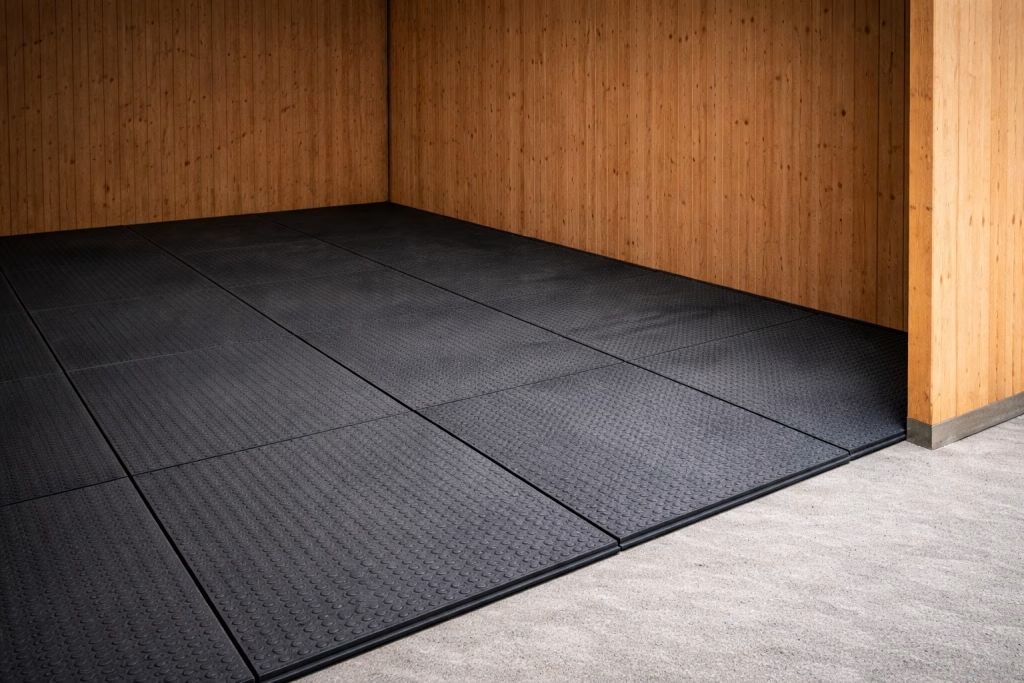
Ecoplank perforated mats help get mud under control, stabilise the ground and improve the safety of horses in the stable, in paddocks and in turnout areas. The Ecoplank ground mat system genuinely reduces wear of the ground, makes it easier to keep things tidy and cuts the running costs of equestrian infrastructure.
Table of contents:
- Why use Ecoplank ground mats in a stable?
- Where do Ecoplank mats work best?
- How do Ecoplank perforated mats work?
- How to choose Ecoplank ground mats for your facility
Why use Ecoplank ground mats in a stable?
Ecoplank ground mats for stables stabilise the ground, spread the pressure of hooves and wheels and help keep a dry, level surface in places where mud and ruts usually form. They provide a stable, non-slip surface, which improves safety for horses, people and vehicles across the yard.
In equestrian facilities, Ecoplank’s ground mats minimise mixing of the working layer with the subsoil and improve drainage, especially in heavily used turnout areas and yards next to the stable. As a result, sand or gravel needs topping up less often and the ground keeps its proper parameters for longer.
Where do Ecoplank mats work best?
Ecoplank ground mats work best in “bottlenecks” – the places with the heaviest traffic in the stable and paddocks. These are mainly:
- entrances to paddocks and pastures, around gates and fence corners, where Ecoplank perforated mats keep mud in check.
- the yard by the stable, horse loading areas, and access for trailers and heavier equipment.
- outdoor routes between the stable, lunging ring, horse walker, wash bay and storage buildings.
Ecoplank ground mats can also be used as a stabilising layer under the riding surface of a lunging ring or arena, which improves drainage and extends the life of the surface. Thanks to their modular design, the same mat system can be used in several zones of a facility, with the layout matched to the actual movement of horses.
How do Ecoplank perforated mats work?
Ecoplank perforated ground mats for mud control are designed to combine ground stabilisation with effective water drainage. Drainage holes and the structure of the mats allow water to drain away quickly, so the surface stays dry and level even under heavy use. Ecoplank ground mats made from recycled plastic provide safe, mud-free surfaces for animals and vehicles. The material is resistant to moisture, rot, microorganisms and UV radiation, which means a long, maintenance-free service life for the system.
How to choose Ecoplank ground mats for your facility
When choosing Ecoplank ground mats for a stable, it is worth starting with an analysis of the daily routes of horses, people and machinery. Ecoplank perforated mats should first be laid where mud appears fastest – at paddock gates, in the stable yard and on key access routes. For heavier loads (equipment access, trailer parking), heavy-duty protective mats providing stable, non-slip surfaces will do the job. In later stages, the Ecoplank ground mat system can be extended to further paddocks, turnout areas and service zones, step by step organising the infrastructure of the whole equestrian centre.
Frequently asked questions
Where should perforated mats be laid first?
In traffic bottlenecks: at entrances to paddocks and pastures, around gates and fence corners, in the stable yard, in horse loading areas and on trailer access routes.
How do the mats reduce mud?
Drainage holes carry water away, and the structure of the mat spreads the pressure of hooves and wheels. The working layer does not mix with the subsoil, so the surface stays dry and level.
Are the mats suitable under an arena or lunging ring surface?
Yes. They can act as a stabilising layer under the riding surface – they improve drainage and extend the life of the footing.
Do the mats need maintenance?
No. The recycled plastic is resistant to moisture, rot, microorganisms and UV radiation, so the mats work for years without any servicing.
Is the surface of the mats non-slip?
Yes. The mats form a stable, non-slip surface, which improves the safety of horses, people and vehicles moving around the facility.
Do the mats reduce footing maintenance costs?
Yes. They limit mixing of the working layer with the subsoil, so sand or gravel needs topping up less often and the footing keeps its proper parameters for longer.