For Animals
Stables and horse boxes in recycled plastic
Recycled plastic boards for equestrian facilities
A stable is one of the hardest places you can put timber. The air is humid all year, the walls get hosed down, the boards are kicked, chewed and leaned on, and ammonia finishes what the water starts. Wood answers by swelling, cupping and splitting, and the maintenance never ends – sanding, oiling, painting, replacing the bottom board every few seasons. Ecoplank boards are made of solid recycled polyolefin, so they take no part in that cycle. They absorb no water, feed no algae, mould or insects, and need no coating to stay serviceable. Below are the four places where riding centres use them most.
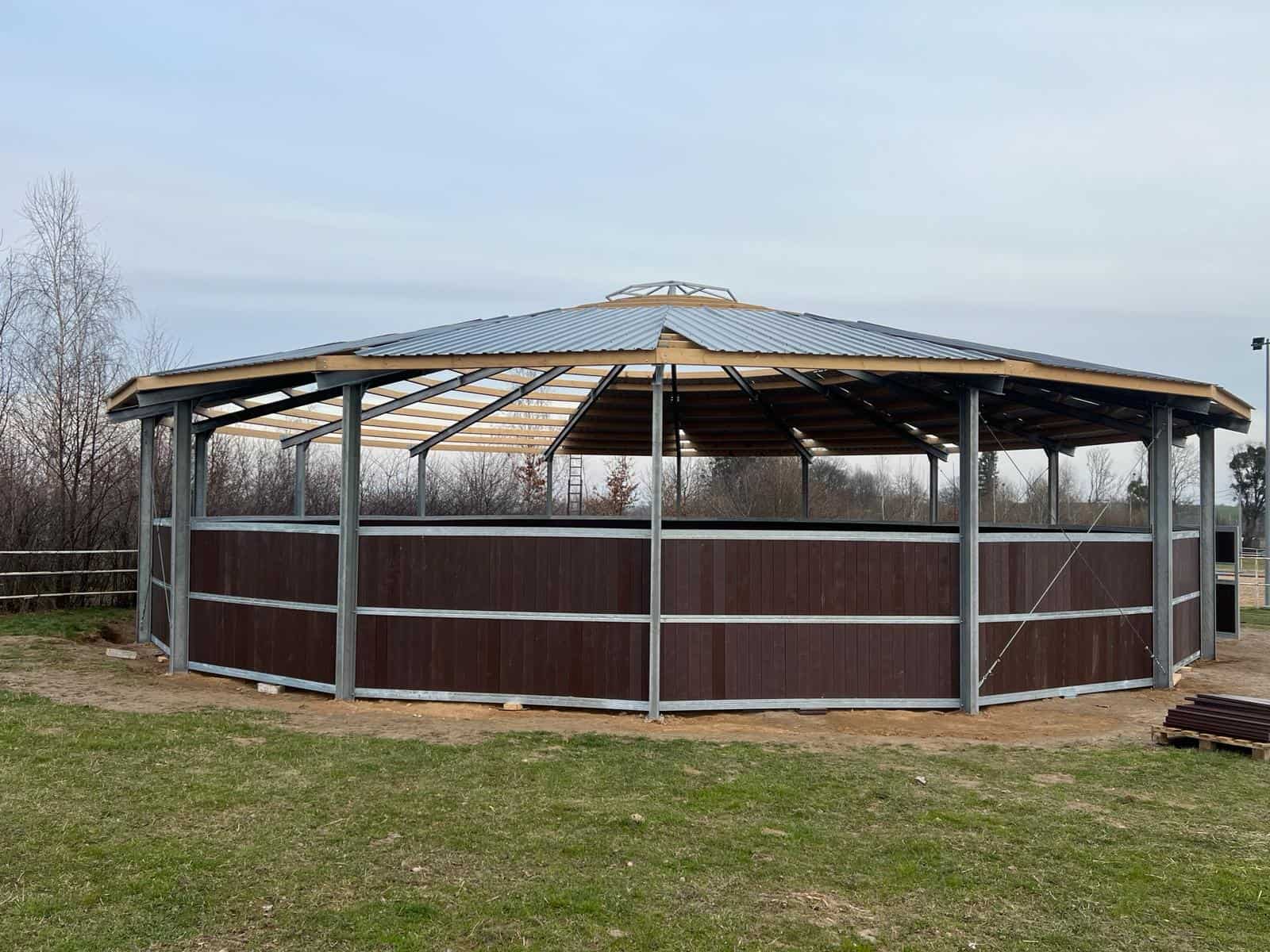
Lunging rings
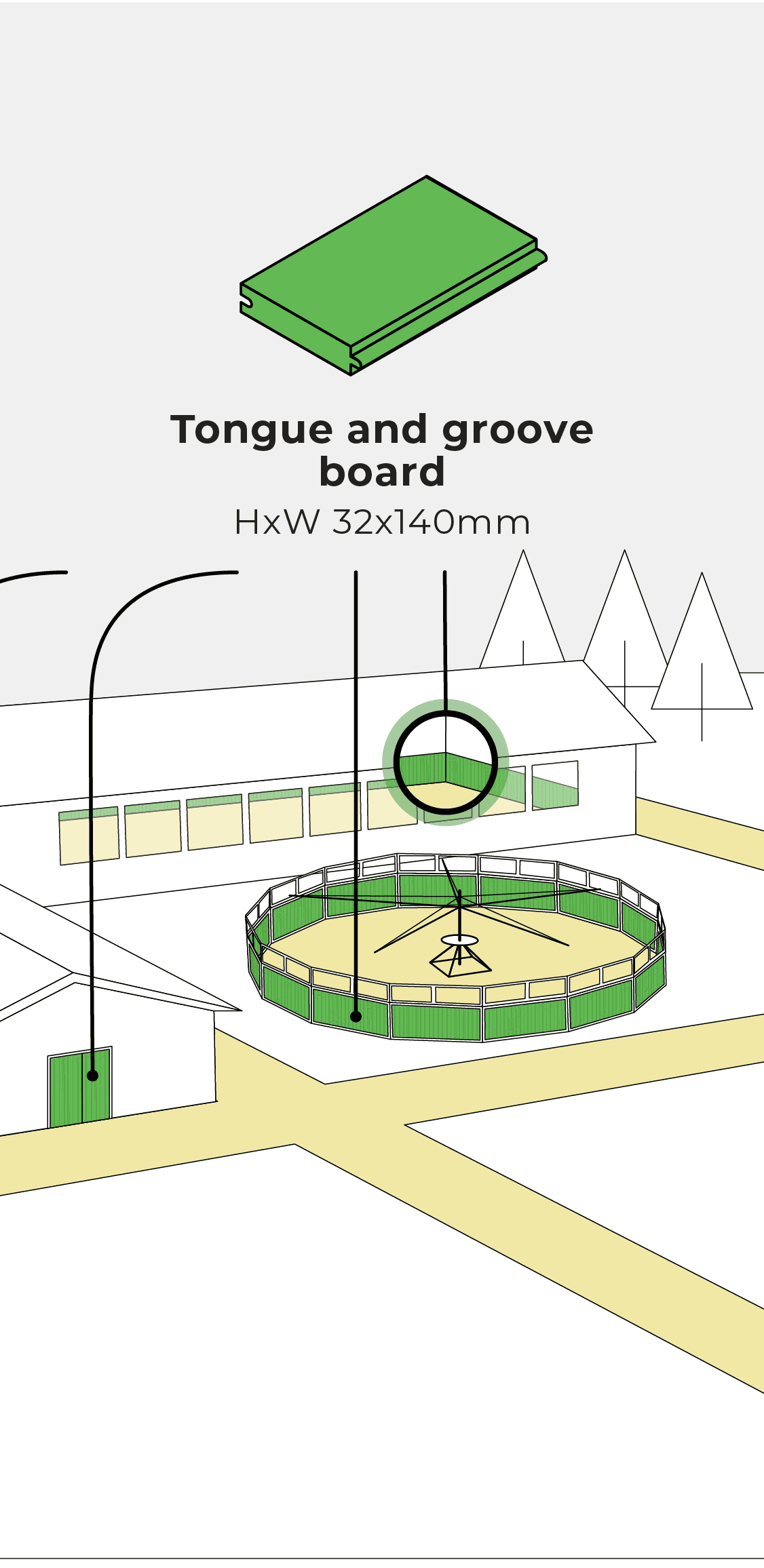
A lunging ring is a curved wall that a horse meets at speed and at an angle. It has to be closed, smooth on the inside and strong enough to take a shoulder or a hoof without a board springing out of its frame. Tongue and groove boards lock into each other and form a continuous surface with no gap for a hoof or a headcollar to catch on, and the shorter 96 cm and 126 cm lengths follow the curve of the ring without forcing the material. Because the board is solid through its whole thickness, a scuff is the same colour as the rest of the board – there is no paint layer to chip and no bare timber to grey off. A lunging ring built this way is finished on the day it goes up and stays that way.
Horse walkers
A horse walker works every day of the year, outdoors, and its panels get splashed, kicked and washed down between groups. That is exactly the duty cycle that destroys plywood and softwood infill: the boards absorb water, delaminate at the edges and start to warp within a season or two. Recycled plastic boards do not absorb water at all, so the panels of a walker stay flat and stay dimensionally stable through freeze and thaw. They can be pressure washed as hard as you like, and there is nothing organic in the material for mould to colonise – a real advantage in a structure that is permanently damp underneath its roof.
Arena kickboards
The kickboard is the most abused surface in an indoor arena. It takes hoof strikes at the bottom, gets buried in damp footing, and in a timber arena it is the first thing to rot and the first thing that needs repainting. A kickboard made from recycled plastic boards solves both problems at once: the bottom of the wall sits in wet sand year after year without rotting, and the colour is the material, not a finish, so the arena never needs a repaint to look maintained. The surface is closed and smooth, which matters when a rider’s boot or a horse’s shoulder brushes along it, and it washes down with a hose when dust builds up.
Horse boxes and stall partitions
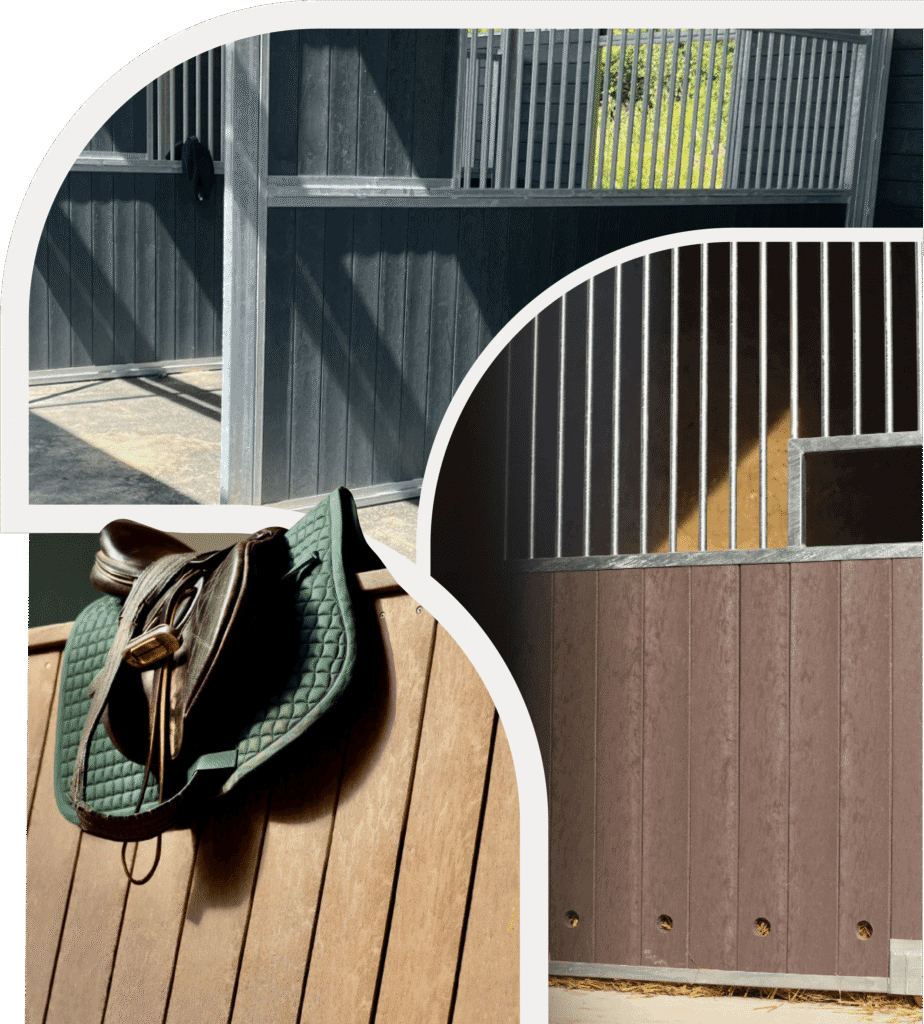
Stall partitions and kick walls are where recycled plastic earns its keep fastest. A box is washed down regularly, the humidity never drops, and the bottom boards of a timber partition are in permanent contact with bedding and urine. Solid recycled polyolefin does not swell when a box is washed down, does not rot at the bottom rail, and gives horses that crib nothing worth chewing. Boards lock together into a closed partition with no visible gap, which keeps neighbouring horses apart and keeps the wall flat under a kick. The same boards are used for stable cladding, shelter walls and the lower half of barn facades that get splashed and hosed all season.
Why recycled plastic instead of timber
- It does not absorb water. No swelling after a wash-down, no cupping in a humid stable, no rot at the bottom rail where timber always fails first.
- Nothing lives on it. No food for algae, mould, fungus or insects, so a wall stays what it was on the day it went up.
- No maintenance coating. No oiling, no sanding, no painting. The colour runs through the whole board, so a scratch or a hoof scuff does not expose a different material underneath.
- It stands up to cleaning. Pressure washing and stable disinfectants do not damage the surface, which matters for biosecurity in a commercial yard.
- Made from recycled plastic. The material is certified 95% recycled content, which turns a stable refit into a documented piece of waste reduction rather than a claim.
- 15-year warranty on the boards.
Which board for which job
- Tongue and groove board TG32x140 – closed, gap-free walls: box partitions, kick walls, arena kickboards, horse walker infill, lunging rings.
- Square board SQ32x150 – a flat board with no tongue, so you set the drainage gap yourself: stable interiors, walkways, shelter cladding.
Both profiles are 32 mm solid recycled polyolefin, supplied in 190 cm, 126 cm and 96 cm lengths, in black, grey, brown, teak and gold, with a 15-year warranty. For the ground under the structure – paddocks, walkways, the base of a lunging ring or a horse walker – the same projects usually combine the boards with Ecoplank ground mats, which stabilise the surface and keep the footing out of the mud.
The cost that matters is the second one
Timber is cheaper on the invoice. It stops being cheaper the first time somebody has to price a weekend of sanding and painting, or replace the bottom two boards of every partition in a twenty-box barn. A recycled plastic wall is bought once and then left alone: no coating to renew, no board to swap out because it rotted from the inside, no season lost to a repaint before an open day. In a yard that is run as a business, the argument is not environmental first and commercial second – it is the same argument twice.
Tell us what you are building and we will tell you which profile, which length and how much of it you need.